


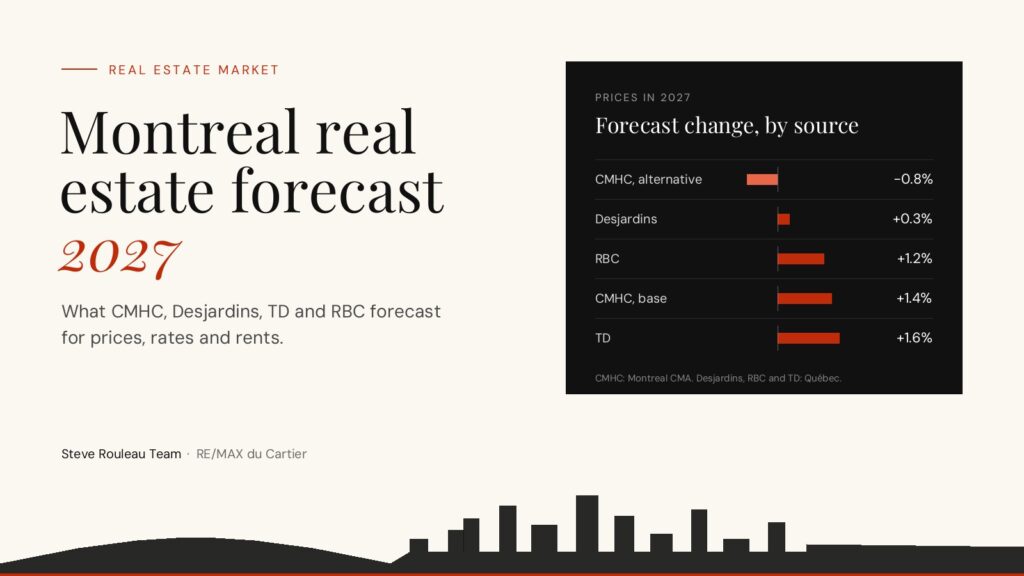
Real estate forecasts for Montreal in 2027 point to a calmer market, with nearly stable prices. According to CMHC, the average price of a property in the metropolitan area would be between $669,100 and $685,000 that year.
What are these forecasts worth, and what do they change for your project?
In this guide, you will find:
- the actual state of the Montreal real estate market in the third quarter of 2026;
- the 2027 forecasts from CMHC, Desjardins, TD and RBC;
- what economists expect for interest rates and rents;
- what these forecasts change for buyers, sellers and investors.
Updated October 26, 2026. We update this article with each new forecast from CMHC, QPAREB or the major banks.
The Montreal real estate market in fall 2026
| Property type | Median price, Q3 2026 | Change over one year | Sales, Q3 2026 | Average selling time |
| Single-family home | $812,000 | +2% | 1,002 (−12%) | 51 days |
| Condo | $477,000 | 0% | 1,728 (−15%) | 67 days |
| Plex (2 to 5 units) | $902,500 | +3% | 614 (−13%) | 52 days |
Source: Centris real estate statistics, island of Montreal, accessed October 26, 2026. Changes compare the third quarter of 2026 with that of 2025.
Sales are falling, supply is rising and prices are holding. On the island, 3,344 properties sold in three months. That is 13% fewer than a year earlier. The number of properties for sale climbed 12%. Condos are the hardest-hit segment. A condo now takes 67 days on average to sell, two weeks longer than in 2025.
QPAREB sees the same trend across the metropolitan area. Sales there fell 12% in the third quarter, a fourth consecutive quarterly decline. Yet the median price of a single-family home reached $645,500, up 2%. For details by borough, see our Montreal real estate prices by neighbourhood.
2027 real estate forecasts for Montreal, source by source
Only CMHC puts numbers on the metropolitan area itself. The banks work at the provincial level.
| Source and date | Territory | Sales in 2027 | Prices in 2027 |
| CMHC, July 22, 2026 | Montreal CMA | 45,300 to 46,500 | Average price of $669,100 to $685,000 |
| Desjardins, July 30, 2026 | Québec | 102,035 (+6.4%) | Average price of $565,000 (+0.3%) |
| TD, September 29, 2026 | Québec | +1.1% | +1.6% |
| RBC, September 1, 2026 | Québec | Measured rebound | Price index +1.2% |
| QPAREB | Montreal CMA | Not yet published | Not yet published |
CMHC: the only Montreal-specific forecast
Canada Mortgage and Housing Corporation (CMHC) publishes forecasts for the census metropolitan area (CMA). Its summer update of the Housing Market Outlook was released on July 22, 2026. In its base scenario, the average price would reach $685,000. In the other, more cautious scenario, it would edge down to $669,100.
On the sales side, it expects 45,300 to 46,500 transactions. That is slightly fewer than the 46,999 sales in 2025. Nationally, the Crown corporation attributes this moderate demand to slow population growth, uncertainty and high borrowing costs. In February 2026, it even expected population decline in the region.
Desjardins: nearly stable prices in Québec
Desjardins Economic Studies publishes forecasts for Québec as a whole. Its Housing Zoom of July 30, 2026 forecasts 102,035 resales next year. That would be a 6.4% increase after a slight decline in 2026. The weighted average price would rise by only 0.3%, to about $565,000.
Economist Maëlle Boulais-Préseault describes a gradual return to balance rather than a correction. This scenario predates their October rate forecasts.
TD and RBC: modest increases in Québec
TD Economics published its provincial forecasts on September 29, 2026. For Québec, it expects sales to rise 1.1% next year. Prices would increase 1.6%. In its view, economic weakness and strained affordability make a modest year likely.
RBC published its own on September 1, 2026. According to its economist Robert Hogue, the province’s price index would rise 6.4% in 2026. The increase would then slow to 1.2% the following year. The bank also expects a measured rebound in sales across the province.
QPAREB: the 2027 forecast is still to come
The Quebec Professional Association of Real Estate Brokers (QPAREB) publishes its annual forecasts early in the year. As of October 26, 2026, its figures had not yet been released. In its quarterly report, Camille Laberge, assistant director of market analysis, raised the possibility of a policy rate increase by the end of 2026 or early 2027. She also expected affordability to keep deteriorating.
Real estate prices in 2027: the range
Side by side, these price forecasts range from a slight decline to an increase of less than 2%:
- CMHC, alternative scenario: about −0.8%;
- Desjardins (province): +0.3%;
- RBC (price index, province): +1.2%;
- CMHC, base scenario: about +1.4%;
- TD (province): +1.6%.
We calculated the two CMHC changes from its forecast prices. All these sources agree: the sharp increase of 2025 would not be repeated. Elsewhere in the country, the Crown corporation expects the smallest price increases in Ontario and British Columbia, home to Toronto and Vancouver. All these figures remain scenarios, revised several times a year.
CMHC and Desjardins forecast an average price, which a few luxury sales can move. RBC tracks a price index. Centris and QPAREB publish median prices instead. These forecasts therefore show the direction of the market. The value of your property, on the other hand, is measured by the sales in your area.
2026 real estate forecasts: the gap with reality
In January 2026, QPAREB expected sales to fall 3% in the CMA. By the third quarter, the decline had reached 12%. CMHC also revised its figures. In February, it expected 46,800 to 50,800 transactions for the year. In July, it expected about 45,400.
On prices, QPAREB’s forecast held up better. It anticipated a median price of $645,000 for a single-family home in 2026. In the third quarter, the actual median was $645,500. Sales forecasts were therefore too optimistic, while price forecasts have been on target so far. Our review of the Montreal real estate market in 2025 describes the year before this slowdown.
Interest rates in 2027: the forecasts
As of October 26, 2026, the Bank of Canada’s policy interest rate was 2.25%, its level since October 2025. The Bank announces its decisions on eight fixed dates a year. On October 22, 2026, Desjardins expected an increase at the October announcement, then another in January 2027. Its economists point to high energy prices, which are keeping inflation up, while employment is showing signs of weakness. As early as February, CMHC also considered a rise in fixed rates likely, because long-term bond yields remain high. It also noted that pandemic-era borrowers have to renew at higher rates.
A variable rate follows the policy rate almost immediately. A fixed rate follows Government of Canada bonds instead. Our mortgage calculator tests your payments at a higher rate. Check the Bank of Canada’s latest decision before setting your budget.
Montreal rental market: 2027 outlook
For a plex owner, the forecast that matters most is the rental market. According to CMHC, the region’s rental vacancy rate was 2.9% in 2025. It would reach 4.5% two years later. The average rent for a two-bedroom unit would keep rising, but more slowly, to $1,455. The reason: many new units are coming onto the market while population growth slows. CMHC also expects about 22,000 housing starts in the region that year, compared with 27,777 in 2025. Desjardins sees the same trend in the province, with a vacancy rate of 3.9% that year.
A plex should now be analyzed with a realistic vacancy rate and moderate rent increases. The most affordable units will nonetheless remain in high demand, the Crown corporation notes. On the island, the supply of plexes for sale rose 16% in one year, leaving more room for negotiation. Our guide to buying a triplex as a first real estate purchase walks through the calculation for an owner-occupant. See also our triplexes for sale in Montreal.
Buying or selling in Montreal in 2027
Buying in a slowing market
If you are buying, the current market gives you more choice than in 2025. Condos in particular are selling more slowly, which reduces the risk of bidding wars. Waiting for prices to drop remains a gamble: the forecasts reviewed range from a slight decline to a modest increase. The best-documented risk is a rise in rates.
Start with a mortgage pre-approval, which can lock in your rate for a period of time. Our specialized mortgage and financing partners can help with this step. Our purchasing power calculator then gives you a realistic first budget. The stress test also checks that you could make your payments at a higher rate than your contract rate. Finally, plan for your down payment, the welcome tax and the notary’s fees.
Since June 10, 2022, the Real Estate Brokerage Act, administered by the OACIQ, has prohibited dual representation in residential brokerage, except in cases provided for by law. A broker tied to the seller cannot represent the buyer of the same property.
Selling when inventory is rising
The starting price matters more than in 2025. With more inventory, buyers compare more. According to QPAREB, the single-family home market still favours sellers in the region’s main areas. Condos call for more careful marketing.
We set the price based on sales closed in your area over the last few months. Forecasts are for reading the trend; comparables are for setting the price. Our method for selling a property in Montreal details each step.
Your property and the 2027 forecasts
Get a free evaluation based on recent sales in your area.
FAQ: Montreal real estate forecasts
Will real estate prices drop in Montreal in 2027?
Forecasts published in 2026 point instead to stability. For the metropolitan area, CMHC expects an average price ranging from a slight decline to an increase of about 1.4%, depending on the scenario. For the province, Desjardins, RBC and TD expect increases of 0.3% to 1.6%. Condos remain the most fragile segment, with more inventory and longer selling times.
What will the average property price be in Montreal in 2027?
According to CMHC’s summer 2026 update, the average price of a property in the metropolitan area would be between $669,100 and $685,000 that year. This average covers all property types, suburbs included. On the island, in the third quarter of 2026, the median condo price was $477,000 according to Centris.
Will mortgage rates rise in 2027?
Several economists expect so. On October 22, 2026, Desjardins anticipated a policy rate increase in October, then another in January 2027. QPAREB also mentions a possible increase by early 2027. Variable rates follow the policy rate. Fixed rates follow Government of Canada bonds instead. A mortgage pre-approval can protect your rate during your search.
Is now a good time to buy in Montreal?
The right time depends mainly on your budget and your time horizon. The 2026 data gives buyers more choice: on the island, supply rose 12% in one year. Forecasts point to nearly stable prices, and several economists expect higher rates. Our buyer support starts with this calculation.
Will the market favour buyers in 2027?
It already partly does for condos. In the third quarter of 2026, QPAREB placed the island’s condo market between balanced and favourable to buyers. For single-family homes, sellers kept the advantage. CMHC expects 2027 sales to remain below 2025 levels. A real estate alert notifies you of new listings in your area.
Will rents drop in Montreal in 2027?
According to CMHC, they would keep rising instead, but more slowly. The average rent for a two-bedroom unit in the region would reach $1,455. The vacancy rate would rise to 4.5%, compared with 2.9% in 2025. The arrival of many new units and slower population growth explain this easing of the rental market.
Why do CMHC and bank forecasts differ?
They cover different territories and indicators. The Crown corporation forecasts the average price for the metropolitan area. Desjardins and TD cover Québec as a whole, which includes tighter markets such as the Québec City region. RBC tracks a price index. Timing matters too: a July forecast predates the fall data and the new rate scenarios.
How can I find out what my property is worth in 2027?
A forecast gives a regional trend. The value of your property depends on recent sales in your area, the condition of the building and its features. A real estate broker has access to these sales on Centris. We establish the market value of your house from these comparables, free of charge, in under 48 hours.
Prepare your real estate project for 2027
Steve Rouleau, your real estate broker in Montreal, helps you read these forecasts for your neighbourhood and property type.