


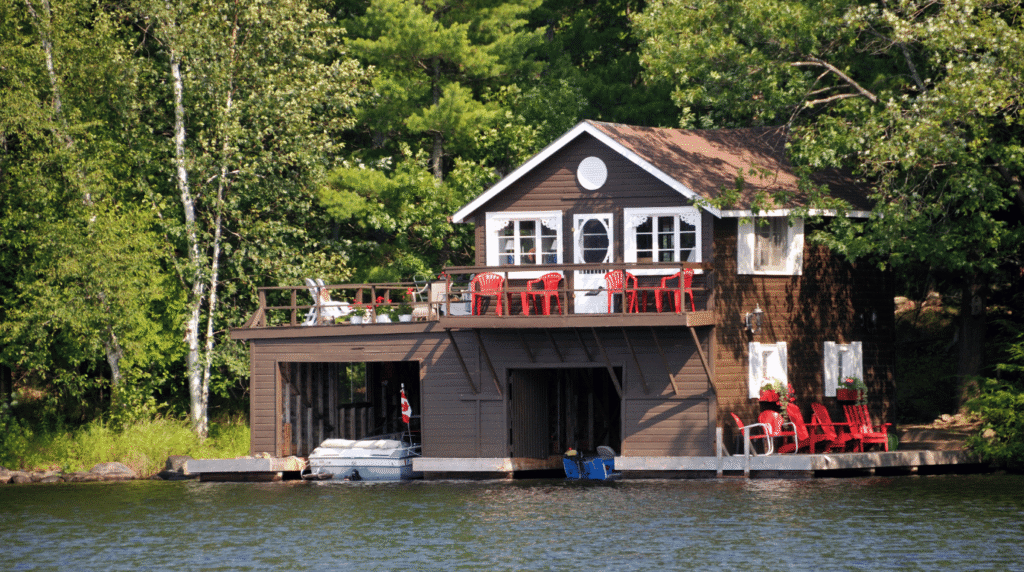
Selling a lakeside cottage, a mountain vacation condo, or an income property raises legal, tax, and practical questions that are very different from those involved in selling a principal residence. Between calculating the capital gain, the anti-flipping tax, the strategic decision to designate a property as a principal residence, and getting the property ready for sale, good planning makes all the difference. This guide, updated for 2026, explains everything you need to know to sell your secondary residence in Quebec, optimize your tax situation, and maximize your selling price.
What Is a Secondary Residence in Quebec?
In Quebec, a secondary residence is any property that isn’t your principal residence — that is, a property not mainly lived in by you, your spouse, or your children. This category covers several property types: a lakeside cottage in the Laurentians, a mountain chalet in the Eastern Townships, a country house in Lanaudière or Mauricie, a vacation condo in Charlevoix or the Eastern Townships, an urban income property, or even an inherited family property you don’t occupy. Each of these cases carries its own tax implications at the time of sale.
The Tax Implications of Selling a Secondary Residence
This is the most important aspect to understand before putting your cottage or secondary residence on the market. Unlike a principal residence, the profit made on the sale of a secondary residence is not tax-exempt by default.
Capital Gain: Definition and Calculation Formula
The capital gain is the difference between your net selling price and your adjusted cost base (ACB). Here is the simplified formula:
Capital gain = Proceeds of disposition (selling price − selling costs) − Adjusted cost base (purchase price + acquisition costs + eligible renovations)
The ACB includes the original purchase price, the original acquisition costs (notary fees, transfer duties, etc.), and all capitalized improvement work carried out over the years. The proceeds of disposition correspond to the selling price, minus the broker’s commission and the notary fees at the time of sale.
The Inclusion Rate in 2026: What You Need to Know
This is where many online guides are out of date. An increase in the inclusion rate to 66.7% had been proposed in 2024 and deferred to January 1, 2026. On March 21, 2025, Prime Minister Mark Carney officially cancelled this increase. The inclusion rate therefore remains at 50% in 2026, as it has been for decades.
In practical terms, only half of your capital gain is added to your taxable income, regardless of the total amount. That portion is then taxed at your combined federal and provincial marginal rate.
The lifetime capital gains exemption for farm property, fishing property, and qualified small business corporation shares remains at $1.25 million as of June 25, 2024. The Canadian Entrepreneurs’ Incentive (a 33.33% inclusion rate on a $2 million lifetime maximum) has also been in effect since 2025.
The Anti-Flipping Tax: A Trap to Avoid
Since 2023, a federal measure known as the “anti-flipping tax” (property flipping) treats any gain realized on a residential property resold within 365 consecutive days (12 months) of its acquisition as business income fully taxable at 100%. For a secondary residence resold quickly, this means no partial inclusion applies: the entire profit is taxed at your marginal rate.
Exceptions are provided for life events that justify a rushed sale: death of a household member, divorce or separation, the birth of a child, a forced job relocation, serious health problems, or a disaster affecting the residence. Outside of these situations, the rule applies strictly, and it must absolutely be taken into account before buying a secondary residence with the idea of reselling quickly.
Eligible Deductions to Reduce Your Capital Gain
Good news: several expenses can reduce your taxable capital gain, provided you’ve kept the invoices. Here are the main deductions:
- Capitalized renovations that durably improved the property (an addition, adding a garage, major insulation work, a brand-new roof)
- Improvement work done to the building, beyond simple routine maintenance
- Original acquisition costs: notary fees at purchase, transfer duties (welcome tax), inspection fees
- Real estate broker’s commission at the time of sale
- Notary fees at the sale and other professional fees (certified appraisal, certificate of location)
Carefully keep all your invoices and receipts from the day of purchase. Without documentation, Revenu Québec and the Canada Revenue Agency can deny the deduction. For optimal tax planning, consulting a tax specialist or a financial planner is strongly recommended.
Tax Calculation: A Concrete Example for a Secondary Residence Sold in 2026
Here is a complete worked example to clearly understand how the calculation works in practice.
Case data:
- Purchase price (in 2010): $200,000
- Acquisition costs (notary, transfer duties, inspection): $5,000
- Capitalized renovations (new roof, addition): $25,000
- Selling price (in 2026): $600,000
- Selling costs (broker’s commission, notary): $30,000
The calculation is done in three successive steps:
- Calculating the adjusted cost base (ACB): $200,000 + $5,000 + $25,000 = $230,000
- Calculating the net proceeds of disposition: $600,000 − $30,000 = $570,000
- Calculating the capital gain and the taxable gain: Capital gain = $570,000 − $230,000 = $340,000, so the taxable gain at 50% = $170,000
| Item | Amount |
|---|---|
| Selling price | $600,000 |
| Less: Selling costs | $30,000 |
| Less: Adjusted cost base | $230,000 |
| Capital gain | $340,000 |
| Taxable gain (50%) | $170,000 |
| Estimated tax (47% marginal rate) | ~$80,000 |
This $170,000 is added to your taxable income for the year, and the actual tax depends on your total income and your combined federal-provincial marginal rate. To understand how the market value used differs from the municipal assessment, see our article on the difference between market value and municipal assessment.
Principal Residence Designation: A Powerful Tax Strategy
This strategy can, in some cases, considerably reduce (or even eliminate) the tax on the capital gain. It’s worth analyzing carefully before the sale.
The Principle of Designation
In Canada, a taxpayer (or a couple) can designate only one property as their principal residence per year. If you own both a house in Montreal and a cottage in the Laurentians, you have to choose, for each year of ownership, which one you designate as your principal residence. The designated residence must have been ordinarily inhabited by you, your spouse, or your children at some point during the year (a cottage used on weekends or during holidays qualifies).
When to Designate the Cottage Rather Than the Main House
The golden rule: designate as your principal residence the one that has seen the greatest appreciation during the years you’ve owned it. If your cottage bought for $200,000 is now worth $600,000 while your Montreal house bought for $400,000 is now worth $700,000, the cottage has a higher gain per year. Designating it for the years of strong appreciation can eliminate a large part of the tax payable, provided you anticipate the impact on the future sale of your main house. A precise calculation with a tax specialist is essential before making this decision, because every year designated to the cottage is a year you can no longer use for the house.
Form TP-274 and T2091(IND)
To make the designation, two separate forms must be completed: Form TP-274 with Revenu Québec (checking box 109 of Schedule G of the tax return) and Form T2091(IND) with the Canada Revenue Agency. Both designations must cover exactly the same years. Forgetting the TP-274 can result in a penalty of $100 per month, up to a maximum of $5,000. That’s why an accountant or tax specialist should assist with this process in the tax return for the year of the sale.
Selling a Cottage or Secondary Residence?
Our team supports you in planning the sale, evaluating the fair market value, and coordinating with your tax specialist to optimize your situation.
Preparing Your Secondary Residence for Sale
Beyond taxes, the practical preparation of the listing often makes the difference between a quick sale at the right price and a property that stagnates on the market.
Choosing a Broker Who Knows the Vacation-Property Market
The secondary residence market works differently from the urban residential market. Buyers are fewer in number, more seasonal, and often based in urban areas (Montreal, Laval, the South Shore) looking for a retreat in the Laurentians, the Eastern Townships, Charlevoix, or Lanaudière. A broker with solid knowledge of these regions and their seasonal dynamics, who is well connected to the metropolitan clientele, will make a real difference. To make this choice well, see our criteria for choosing the right real estate broker.
Home Staging Adapted to Seasonal Properties
Home staging a secondary residence follows slightly different rules from staging a main house. The goal is to bring out the recreational character and the relaxation potential: a fireplace shown off to advantage, a well-arranged deck, a lake view opened up by a thorough cleaning of the windows. Decluttering and a deep clean, completed by professional photography and a virtual tour, attract more serious buyers. To sell your property at the best price, polished marketing remains your strongest asset.
Technical Documents for Off-Grid Properties (Water, Septic System)
Most secondary residences are not connected to municipal water and sewer systems. Buyers (and their notary) will systematically request technical documents to validate the property’s compliance: a recent drinking-water analysis demonstrating the quality of the well water, and a plan of the septic tank or septic installation compliant with current standards. An up-to-date certificate of location, along with proof of regular septic tank inspection, reassures the buyer and facilitates the notarial transaction.
Special Cases: Inheritance, Rental, and Family Co-Ownership
Three situations deserve particular attention. If you have inherited a secondary residence, the fair market value at the time of death becomes the acquisition cost for the estate, and any gain between that FMV and the selling price is taxable at 50%. To handle this situation well, see our complete guide on selling an inherited house in Quebec.
If you have rented out your secondary residence part of the time, it’s considered a source of income, and the “ordinarily inhabited” qualification may be affected. The general rule is that a residence regularly offered for rent isn’t eligible for the principal residence designation. For owners hesitating between selling and keeping the property to rent, see our guide on investing in a rental property.
Finally, in the case of family co-ownership (siblings co-owning a cottage), the decision to sell must be unanimous, and each co-owner declares their proportional share of the capital gain on their own tax return. If you reinvest the proceeds of the sale in a new property, our mortgage calculator can help you plan your next purchase.
Frequently Asked Questions About Selling a Secondary Residence
How Can You Avoid the Anti-Flipping Tax on the Sale of a Secondary Residence?
The anti-flipping tax applies to any residential property resold within 365 days of its acquisition, taxing the gain as business income at 100%. To avoid this tax, the simplest rule is to hold the secondary residence for at least 12 months before reselling it. Exceptions exist for unforeseeable life events: death, divorce or separation, the birth of a child, a major health problem, or a forced job relocation. If one of these situations applies to you, keep all the documents proving the event.
Do You Have to Pay GST and QST on the Sale of a Cottage?
As a general rule, no. The sale of a secondary residence used for personal purposes (a cottage or vacation condo occupied by the owner and their family) is exempt from GST and QST. The situation changes if the property was used mainly for short-term rental (Airbnb, for example) or as a genuine income property generating revenue: in those cases, GST and QST may apply. A tax specialist should be consulted to validate your specific situation.
What Should You Do if You Inherit a Secondary Residence?
When you inherit a secondary residence, it’s deemed to have been acquired at its fair market value at the time of the previous owner’s death. This FMV becomes your new acquisition cost. If you sell shortly after the death, the capital gain will generally be small. If you wait several years before selling, any gain accumulated between the date of death and the sale will be taxable at 50%.
Can a Rented Cottage Be Designated as a Principal Residence?
Generally no. The principal residence designation requires that the property has been “ordinarily inhabited” by you, your spouse, or your children. A property that is mainly rented doesn’t meet this criterion and loses eligibility. However, if the rental was only occasional (a few weeks a year) and you regularly stayed there, certain years of designation may remain eligible. The situation must be analyzed on a case-by-case basis by a tax specialist.
How Long Does It Take to Sell a Cottage in Quebec?
The timeframe depends heavily on the vacation-property market, the season, and the condition of the property. On average, a well-located and well-prepared cottage sells in 60 to 120 days in the popular regions (the Laurentians, the Eastern Townships, Charlevoix). Spring and early summer are the most active seasons for selling a secondary residence in Quebec, because buyers better visualize the property’s recreational potential during the warm season. A listing in the fall or winter can lengthen the time it takes to sell.
Entrust the Sale of Your Secondary Residence to an Experienced Team
Our team supports owners in selling their cottage or secondary residence with rigor and optimal tax planning. Discover our properties for sale, explore our expertise in neighborhoods like Outremont, or speak directly with our team.